These tow trucks are great for transporting larger vehicles, including buses and tractor-trailers. They're also frequently used to recover vehicles that have become stuck in mud or snow.
Wheel lift tow trucks have a hydraulic boom that slips under a car’s front or back wheels. The operator can then lift either the front or rear end of the vehicle. They’re typically used to haul parked cars that need to be towed to repair shops.
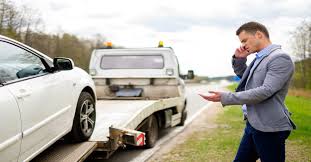
There are several steps that you can take to stay safe while waiting for a tow truck. Always make sure to find a safe location out of traffic and turn on your hazard lights to let other drivers know that you are stopped.
This type of tow truck can carry a vehicle on its bed, or on a winch system that stretches across the flatbed. Its body length can range from nineteen to twenty-two feet, ensuring that there’s enough space for a vehicle or for towing equipment. In some cases, this tow truck has steel upright stanchions, or stakes, that are used to retain the load on the flatbed.
Integrated tow trucks are a type of towing truck designed for heavy-duty vehicles like buses and even big rig trucks. Their design is all about power, as they have an extra axle for added strength and stability. These powerful tow trucks are often used for removing and transporting large commercial vehicles from accident scenes, as well as in overdue parking / illegal parking situations and vehicle repossession.
Check the weight and size of the vehicle you are transporting to ensure your truck is up to the task. Also, regularly inspect all equipment to prevent unnecessary breakdowns and injuries.
They’re also used to haul a wide range of off-road vehicles, including commercial semis (with or without trailers attached), motorhomes, and other recreational vehicles. Integrated tow trucks are also popular for off-road recovery, as they can easily maneuver through challenging terrain to retrieve stranded vehicles. They’re also ideal for large-scale accident responses and removing vehicles from busy roads to avoid traffic disruption.
A flatbed tow truck has a slanted platform on its rear that allows cars to drive into it. It’s the preferred choice for long-distance hauling, as well as for four-wheel-drive vehicles and damaged vehicles. It also comes in handy when a car needs to be moved around a parking lot or a garage.
An integrated tow truck has a wheel lift and boom combined into one unit, which makes it very easy to clamp onto a vehicle. Their arm is also positioned directly in the center of the truck for increased stability and strength, meaning they’re able to pull loads that are bigger than the tow truck itself!
Medium-duty tow trucks have a maximum load capacity of about 20 tons. They’re a great option for when you have to tow something that’s too big for a light-duty tow truck but not quite as large as a heavy-duty tow truck.
Medium-duty tow trucks are perfect for in-between jobs and are a great choice when a flatbed isn’t needed. These trucks can be equipped with various types of flatbeds, and are able to transport up to 17,000 lbs. They are a good option for towing overturned vehicles and recovering large commercial vehicles. Medium-duty tow trucks also usually have rotator booms that can be positioned in challenging positions.
There are several different towing chains that can be used with these tow trucks, depending on the specific needs of a company. For example, a v-chain assembly is great for towing cars because it has two chain "legs" with a frame hook at each end. These chains also have protective covers at the connection point, which helps protect a vehicle from chain damage. Other tow chain options include R hooks for towing Ford vehicles and cluster hooks for towing a variety of vehicles. These hooks fit into factory holes in a vehicle's frame, making them quick and easy to attach.
Most of the tow trucks used for hauling vehicles to junkyards and transporting disabled cars to repair shops are medium-duty. These tow trucks are nimble and small, making them easier to maneuver in tight spaces like parking garages.
Different Types of Tow Trucks
In addition to their weight capacity, heavy-duty tow trucks are required to have specific features to comply with Department of Transportation (DOT) regulations. They must have a specific cargo capacity and height to ensure they can legally drive on public roads. Additionally, they're often required to have a driver that has a commercial drivers license and tow truck endorsement to operate them. This is to ensure that the driver has the knowledge and training to handle a large, heavy vehicle properly.
There are several types of flatbed tow trucks, including tray-style and fixed bridge. Tray-style flatbeds have three rows of tie downs down the length of their beds, while fixed bridge flatbeds have a single deck with no sides. A fixed bridge flatbed is more stable and is able to transport larger vehicles such as trailers without the risk of them shifting during transportation. These trucks are also commonly used for hauling tractors and other heavy machinery. They are also useful for towing vehicles in tight spaces, such as a parallel parked car or an underground garage. These tow trucks are also easy to use, as they don’t require the same level of pre-checking as other types of towing trucks.
Tow trucks play a critical role in the transportation industry. Towing companies rely on different kinds of tow trucks to safely transport vehicles between locations.
The classic towing vehicle you probably see most often in movies and television is a hook and chain tow truck. This tow truck is what most people think of when they imagine a tow truck, and it was the most common type used once upon a time. A hook and chain tow truck uses a crane with a chain to lift one end of a vehicle, then drags it to its destination. This method of towing is not especially friendly to cars and can cause damage, so it is only used for vehicles that are totaled or need to be towed to junkyards.
Wheel Lift
Another advantage of a wheel lift tow truck is its durability. Unlike the hidden wheel lift, which attaches to the frame of the truck, this type of lift is attached to the front of the truck and is less likely to damage it over time. It’s also easier to install and has a longer lifespan.
Different Types of Tow Trucks
A good response time is about 20 minutes if the car is on the highway. If the car is in a safe area, it may take about 30–45 minutes. If you are stranded on the side of the road, you should ask how long it will take to reach you. Ideally, you want to find a company that can reach you in 30–60 minutes
Ask what vehicles they can tow, what type of towing services they offer, and what other services they offer.
Know what modes of payment are acceptable. Some tow trucks only accept cash.
Ask for an estimate cost.
Ask if your auto insurance will work.
Ask where your car will be taken and how and where they will take your vehicle.