
What is Title IX?
Your attorney can gather evidence for your case and challenge the credibility of the accuser. This can be done by presenting an alibi, raising consent as a defense or providing a character witness who can attest to your reputation for honesty and integrity.
During the evaluation, the provider must consider its admissions policy and procedures, treatment of students, and employment of academic and non-academic personnel working in connection with the providers educational program or activity. It is also required to assess whether any discriminatory conduct occurs, and must document its findings and remedies.
If the school decides not to impose sanctions, they must give both parties notice in writing of the reasons for their decision and a right to appeal it. Sanctions can include a suspension, which can be very detrimental to your future and could affect your ability to continue your studies or get into another college or university.
Title IX is a federal civil rights law that prohibits discrimination on the basis of sex in any educational program or activity that receives federal funding. This includes schools and colleges, as well as many private institutions.
A Title IX investigation and disciplinary process is often complex and involves multiple parties, such as an investigator, a disciplinary board, a student panel, the school president, and more. It can be stressful and overwhelming to deal with a Title IX accusation, but it is important to remember that you are protected by the laws of Connecticut.
Title IX is a federal statute that protects students and employees of all programs, activities and institutions that receive federal funding. It prohibits discrimination against males, females and transgender individuals based on their gender and protects them from sexual harassment, violence and retaliation.
The Title IX common rule, however, contains several exceptions to its general prohibition on sex discrimination. For example, a recipient may operate or sponsor separate teams for members of each sex where the selection is based on competitive skill or the activity involved is a contact sport.
Retaliation
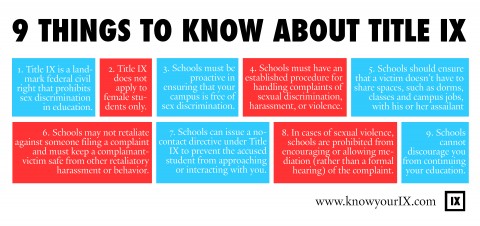
Under the Education Amendments of 1972, colleges and universities are required to adopt policies and procedures to address issues of sex discrimination and harassment. These policies must include procedures for filing a complaint of sex discrimination and for resolving complaints of sexual misconduct.
How can I protect my rights?
Your attorney can also fight for your rights if the school has suspended you for a violation of Title IX. This can have severe consequences on your career and can impact your graduation date, so it’s important to find an attorney who understands your legal rights.
Once a complaint is filed, the school must investigate it and take action to resolve it. This can include disciplinary action, such as suspension or expulsion, depending on the nature of the charges.
One of the best ways to protect yourself from being abused by the state is to be aware of your rights. This can be done by becoming familiar with your state’s civil rights laws and courtroom procedures. Moreover, it may be worth your while to hire an attorney who is both knowledgeable and courteous. If you’re a woman and have experienced gender discrimination at the hands of your employer or the state, then you need someone on your side who will fight the good fight on your behalf. Fortunately, the state of Connecticut has a large number of attorneys who are dedicated to protecting women’s legal rights. Whether you are facing discrimination at work or you want to sue your government for civil rights violations, you should contact an experienced Connecticut Title IX Lawyer right away. You’ll be glad you did. We’ll give you the legal advice you need and make sure that your rights are protected to the fullest extent of the law.
A student who is facing a degree revocation proceeding should hire an experienced legal team with specific experience in handling matters related to academic misconduct. These lawyers should be familiar with the particular complexities and rules of this type of litigation, which can often result in a lengthy and difficult defense.
In addition, a recipient of federal funding is required to provide an assurance that it will comply with Title IX for the period during which the funding is extended. The assurance obligates the recipient to maintain a program or activity free of discrimination based on sex and requires it to notify all persons involved in the operation of the program or activity of its compliance with the statute.
Students should also take their charges seriously, especially if they involve a form of dishonesty such as cheating, plagiarism or falsification. These forms of misconduct are a clear indication that a student may have a serious character issue and a lack of integrity.
Appeals
Many professional licensing boards are interested in learning about any issues of academic integrity that may have arisen during the course of obtaining his or her degrees, and this can be an important concern if the student is hoping to earn a license in a field such as law, medicine, accounting, financial advising or other fields in which a lack of integrity could harm their reputation.
Title IX Lawyer Connecticut
However, these kinds of interactions can easily lead to a retaliation claim against the accused student, which could then lead to additional disciplinary charges and possible sanctions under the school's handbook. This is why it is so important that all students and parents understand their school's policies on sexual misconduct and no-contact orders. Moreover, the sooner the accused student consults with an experienced Connecticut retaliation lawyer, the better their chances of defending themselves in a hearing.